Quick Guide & Tips

💻   Accessing Utils File and Helper Functions

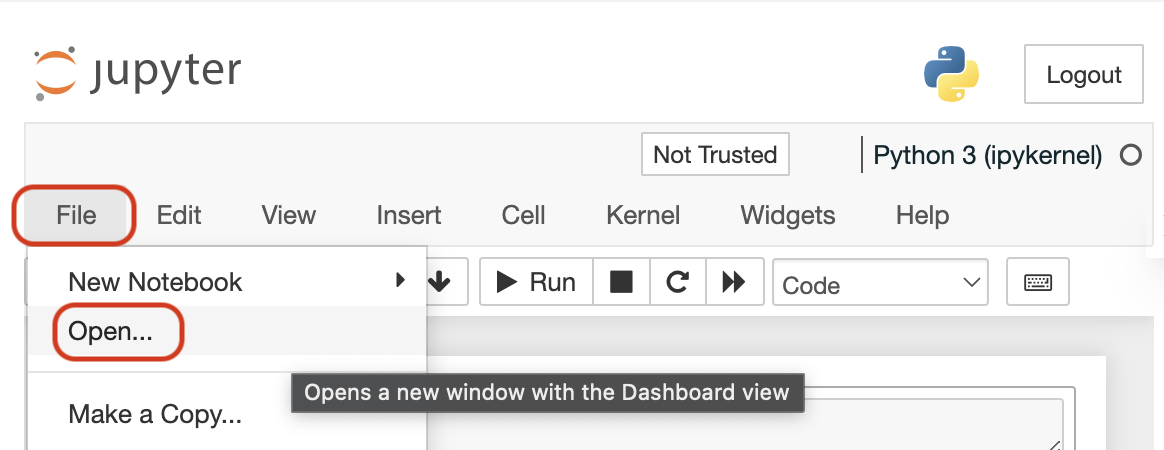
In each notebook on the top menu:

1:   Click on "File"

2:   Then, click on "Open"

You will be able to see all the notebook files for the lesson, including any helper functions used in the notebook on the left sidebar. See the following image for the steps above.

🔄   Reset User Workspace

If you need to reset your workspace to its original state, follow these quick steps:

1:   Access the Menu: Look for the three-dot menu (⋮) in the top-right corner of the notebook toolbar.

2:   Restore Original Version: Click on "Restore Original Version" from the dropdown menu.
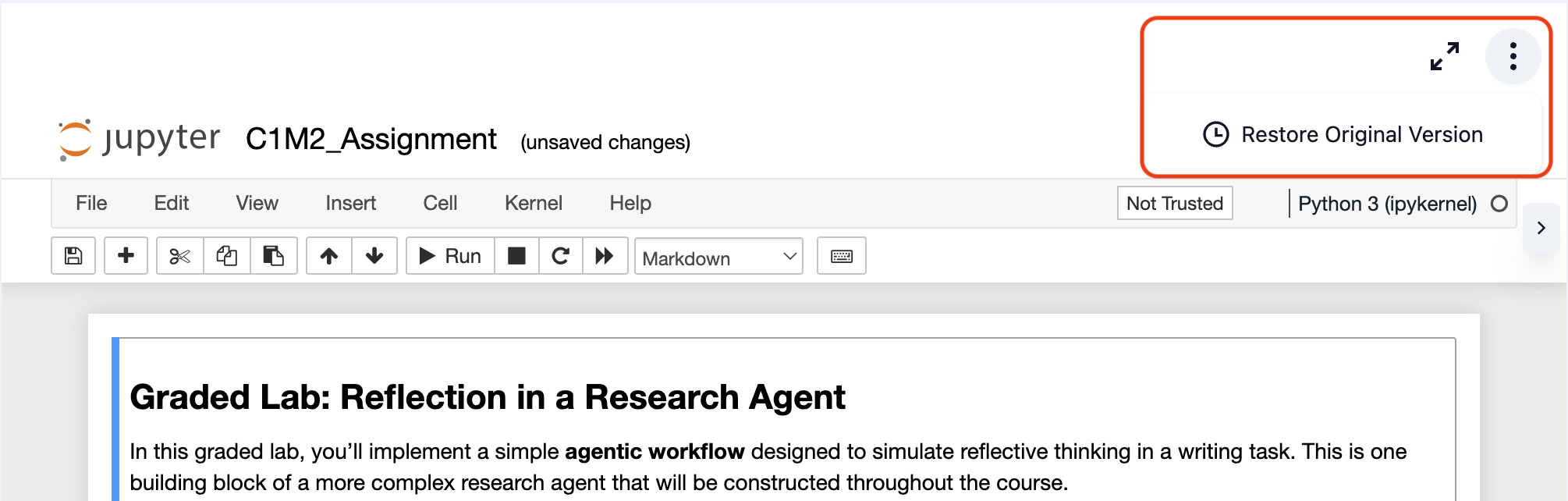
For more detailed instructions, please visit our Reset Workspace Guide.


💻   Downloading Notebooks

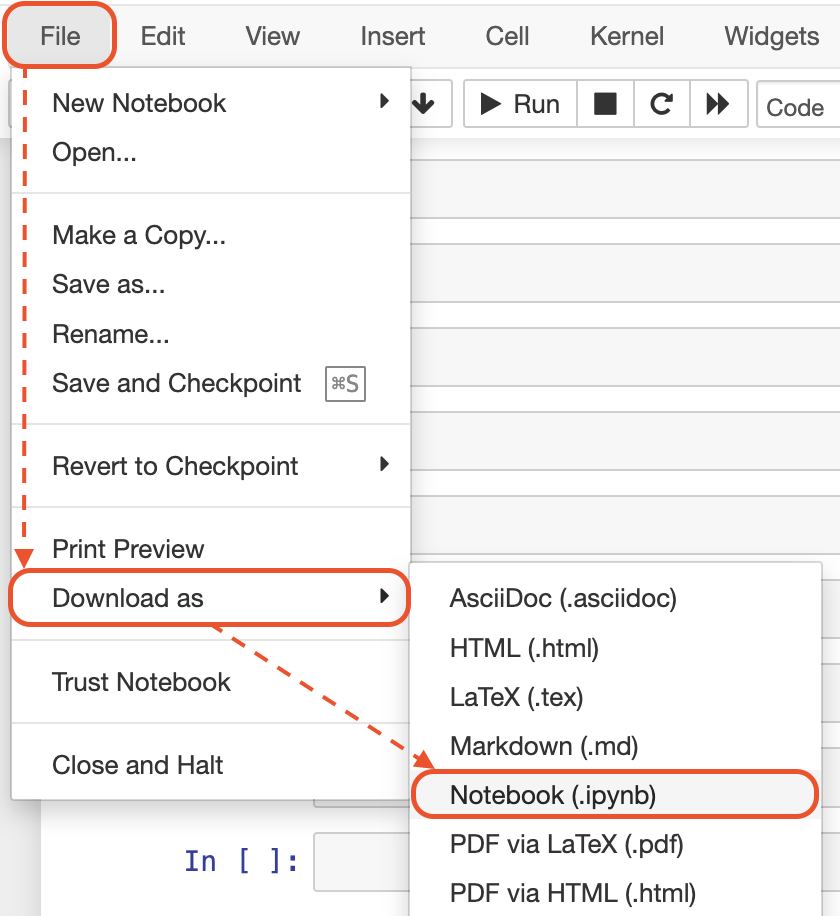
In each notebook on the top menu:

1:   Click on "File"

2:   Then, click on "Download as"

3:   Then, click on "Notebook (.ipynb)"

💻   Uploading Your Files

After following the steps shown in the previous section ("File" => "Open"), then click on "Upload" button to upload your files.


📗   See Your Progress

Once you enroll in this course—or any other short course on the DeepLearning.AI platform—and open it, you can click on 'My Learning' at the top right corner of the desktop view. There, you will be able to see all the short courses you have enrolled in and your progress in each one.

Additionally, your progress in each short course is displayed at the bottom-left corner of the learning page for each course (desktop view).


📱   Features to Use

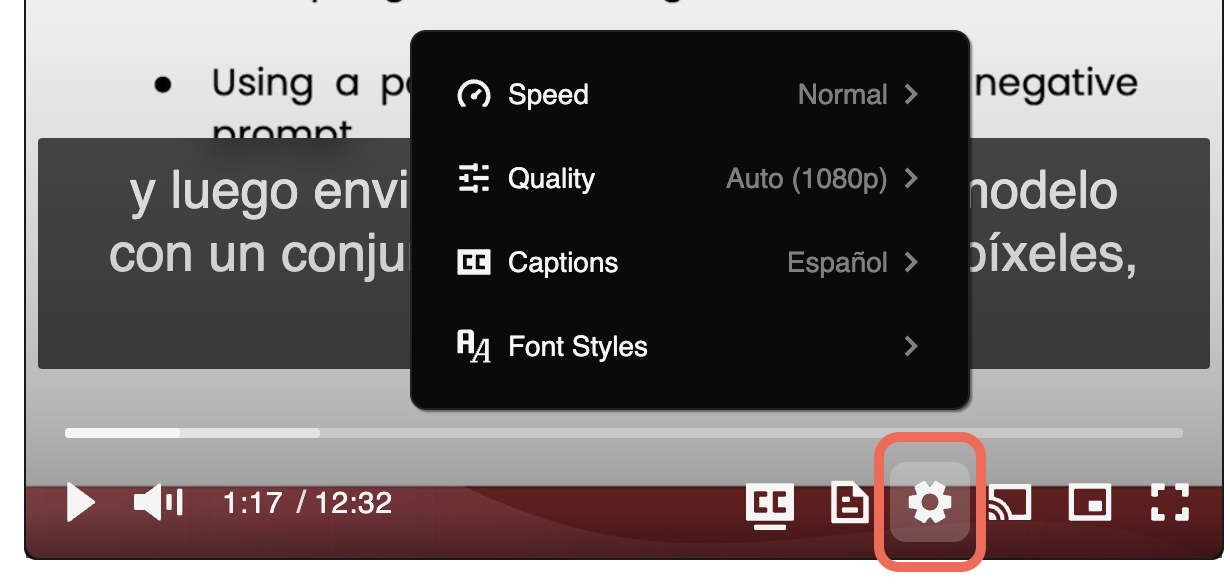
🎞   Adjust Video Speed: Click on the gear icon (⚙) on the video and then from the Speed option, choose your desired video speed.

🗣   Captions (English and Spanish): Click on the gear icon (⚙) on the video and then from the Captions option, choose to see the captions either in English or Spanish.

🔅   Video Quality: If you do not have access to high-speed internet, click on the gear icon (⚙) on the video and then from Quality, choose the quality that works the best for your Internet speed.
🖥   Picture in Picture (PiP): This feature allows you to continue watching the video when you switch to another browser tab or window. Click on the small rectangle shape on the video to go to PiP mode.

√   Hide and Unhide Lesson Navigation Menu: If you do not have a large screen, you may click on the small hamburger icon beside the title of the course to hide the left-side navigation menu. You can then unhide it by clicking on the same icon again.


🧑   Efficient Learning Tips

The following tips can help you have an efficient learning experience with this short course and other courses.

🧑   Create a Dedicated Study Space: Establish a quiet, organized workspace free from distractions. A dedicated learning environment can significantly improve concentration and overall learning efficiency.

📅   Develop a Consistent Learning Schedule: Consistency is key to learning. Set out specific times in your day for study and make it a routine. Consistent study times help build a habit and improve information retention.

Tip: Set a recurring event and reminder in your calendar, with clear action items, to get regular notifications about your study plans and goals.

☕   Take Regular Breaks: Include short breaks in your study sessions. The Pomodoro Technique, which involves studying for 25 minutes followed by a 5-minute break, can be particularly effective.

💬   Engage with the Community: Participate in forums, discussions, and group activities. Engaging with peers can provide additional insights, create a sense of community, and make learning more enjoyable.

✍   Practice Active Learning: Don't just read or run notebooks or watch the material. Engage actively by taking notes, summarizing what you learn, teaching the concept to someone else, or applying the knowledge in your practical projects.


📚   Enroll in Other Short Courses

Keep learning by enrolling in other short courses. We add new short courses regularly. Visit DeepLearning.AI Short Courses page to see our latest courses and begin learning new topics. 👇

👉👉 🔗 DeepLearning.AI – All Short Courses [+]


🙂   Let Us Know What You Think

Your feedback helps us know what you liked and didn't like about the course. We read all your feedback and use them to improve this course and future courses. Please submit your feedback by clicking on "Course Feedback" option at the bottom of the lessons list menu (desktop view).

Also, you are more than welcome to join our community 👉👉 🔗 DeepLearning.AI Forum


Sign in

Or, sign in with your email
Email
Password
Forgot password?
Don't have an account? Create account
By signing up, you agree to our Terms Of Use and Privacy Policy

Create Your Account

Or, sign up with your email
Email Address

Already have an account? Sign in here!

By signing up, you agree to our Terms Of Use and Privacy Policy

Choose Your Plan

MonthlyYearly

Change Your Plan

Your subscription plan will change at the end of your current billing period. You’ll continue to have access to your current plan until then.

Learn More

Welcome back!

Hi ,

We'd like to know you better so we can create more relevant courses. What do you do for work?

Join Team Success

You have successfully joined undefined

You now have access to all Pro features. Click below to start learning!

Course Syllabus

DeepLearning.AI
  • Explore Courses
  • Membership
  • Community
    • Forum
    • Events
    • Ambassadors
    • Ambassador Spotlight
  • My Learning
Welcome back. In this course, you'll learn how to use TensorFlow to process text for natural language processing. Unlike images, which come in these regular-shaped tensors of pixel intensity values, text is messier. There are long sentences, there are short sentences, and do you want to process individual characters, alphabets, or do you want to process words? So in this course, you'll learn how to deal with all that. Yes, so like in our first week as well, we're going to take a look at what it takes for you to process text, because neural networks generally deal in numbers, right? There's your functions calculating weights and biases, it's all numbers. So how are we going to convert our text into numbers in a sensible way? Like given a word like cat, how do you turn down a set of numbers that you can feed into a neural network? Exactly. And then if I have cat, then what's dog going to look like? And all of those kinds of things. And then multiple-length sentences as well, how do we deal with padding them? Or if you've got like a body of words that you use for training, and then you've another body of words that you want to actually predict on, that you're going to have some words in this body that aren't in that one, and how do you deal with out-of-vocabulary tokens and that kind of thing? So it's going to be a lot of fun. Yeah, so in this first week, you learned how to load into text, pre-process it, and set up your data so it can be fed to neural network. And I'm really excited in this course, you learned how to deal with text using TensorFlow. So let's go on to the next video to get started.
specialization detail
  • TensorFlow Developer Professional Certificate
  • Natural Language Processing in TensorFlow
    • Introduction to TensorFlow for Artificial Intelligence, Machine Learning, and Deep LearningCourse 1
    • Convolutional Neural Networks in TensorFlowCourse 2
    • Natural Language Processing in TensorFlowCourse 3
    • Sequences, Time Series and PredictionCourse 4

    • View All Courses
  • Week 1
    • Week 1: Sentiment in text
    • Week 2: Word Embeddings
    • Week 3: Sequence models
    • Week 4: Sequence models and literature
Next Lesson
Week 1: Sentiment in text
    Introduction
  • Introduction: A conversation with Andrew Ng
    Video
    ・
    1 min
  • Welcome to the course!
    Reading
    ・
    1 min
  • Sentiment in text
  • Introduction
    Video
    ・
    1 min
  • Word based encodings
    Video
    ・
    2 mins
  • Using APIs
    Video
    ・
    2 mins
  • Join the DeepLearning.AI Forum to ask questions, get support, or share amazing ideas!
    Reading
    ・
    2 mins
  • About the notebooks in this course
    Reading
    ・
    5 mins
  • Check out the code! (Lab 1)
    Code Example
    ・
    20 mins
  • Notebook for lesson 1
    Video
    ・
    1 min
  • Text to sequence
    Video
    ・
    3 mins
  • Padding
    Video
    ・
    2 mins
  • Out-of-Vocabulary Words
    Video
    ・
    1 min
  • Check out the code! (Lab 2)
    Code Example
    ・
    20 mins
  • Notebook for lesson 2
    Video
    ・
    3 mins
  • Sarcasm, really?
    Video
    ・
    2 mins
  • Preprocessing the Sarcasm dataset
    Video
    ・
    1 min
  • News headlines dataset for sarcasm detection
    Reading
    ・
    2 mins
  • Check out the code! (Lab 3)
    Code Example
    ・
    20 mins
  • Notebook for lesson 3
    Video
    ・
    2 mins
  • Week 1 Quiz

    Graded・Quiz

    ・
    30 mins
  • Week 1 Wrap up
    Video
    ・
    1 min
  • Lecture Notes (Optional)
  • Lecture Notes Week 1
    Reading
    ・
    1 min
  • Weekly Assignment - Explore the BBC News Archive
  • Assignment Troubleshooting Tips
    Reading
    ・
    5 mins
  • Explore the BBC news archive

    Graded・Code Assignment

    ・
    3 hours
  • Next
    Week 2: Word Embeddings